Garlic
For Availability scroll down.
I have one variety of garlic, the original garlic came from Ukraine many years ago, and I have been growing it for 11 years now (my mother was growing it many years prior to that). The closest variety I can identify it with is Bogatyr - the most desirable gourmet garlic on the market. On the flavor/spiciness scale, its about 8 (0-10 scale, 10 being the hottest). Use for food as well for seed.
Bogatyr Garlic
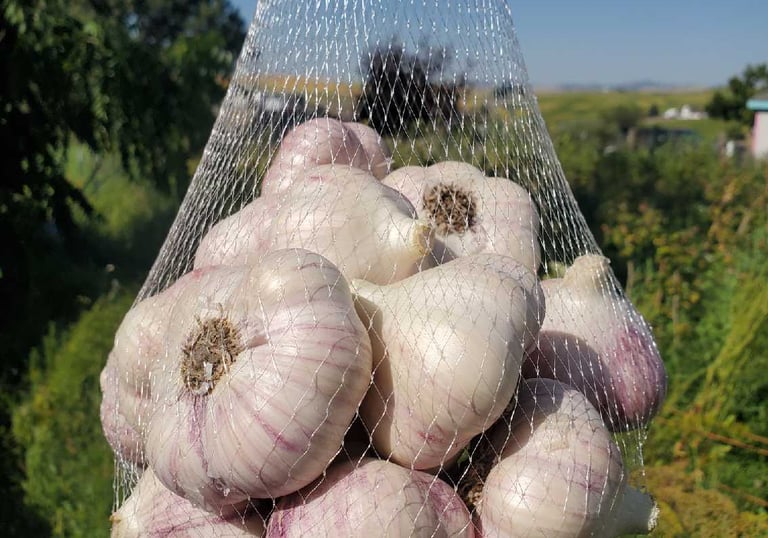
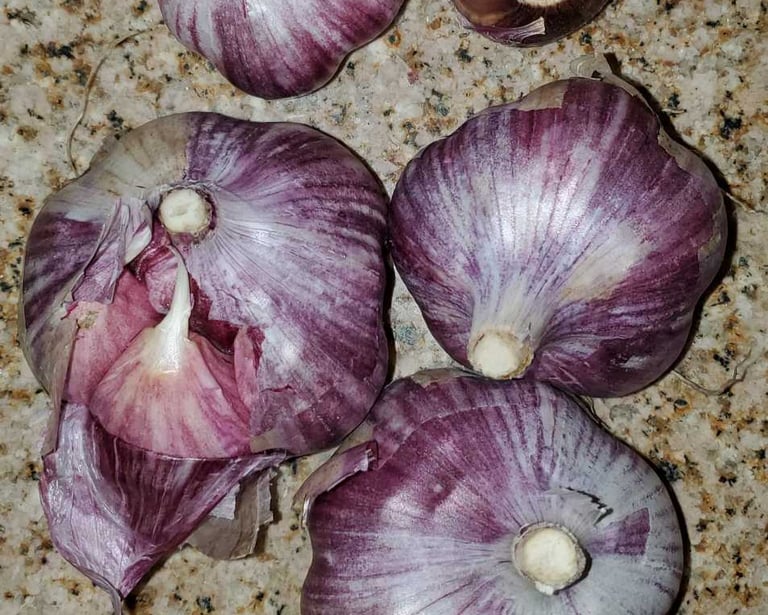
Bogatyr garlic is Marble Purple Stripe garlic cultivar, also known as Russian Penicillin. It is hardneck variety that is beautiful in form and true garlic flavor - known for its fiery, raw heat. Bogatyr garlic also has high allicin content, which makes it great for health benefits. This garlic yields the largest bulbs of all the hardneck and striped garlic cultivars. The outside skin is white to white-purple. As you peel away the outer skins, more and more purple striping shows up and they become almost solid purple by the time you get down to the cloves. The clove skins are dark brown with purple streaks that are smooth and shiny. The bulb yealds on average 5 cloves per garlic bulb, but could have 2-9 cloves. It thrives in cold winter climates but can also grow in warm winter climates. It also has a notably longer shelf life than other marbled purple stripe garlic varieties; store in cool (55°-70°F), dark and dry place for up to 8-10 months.
Size
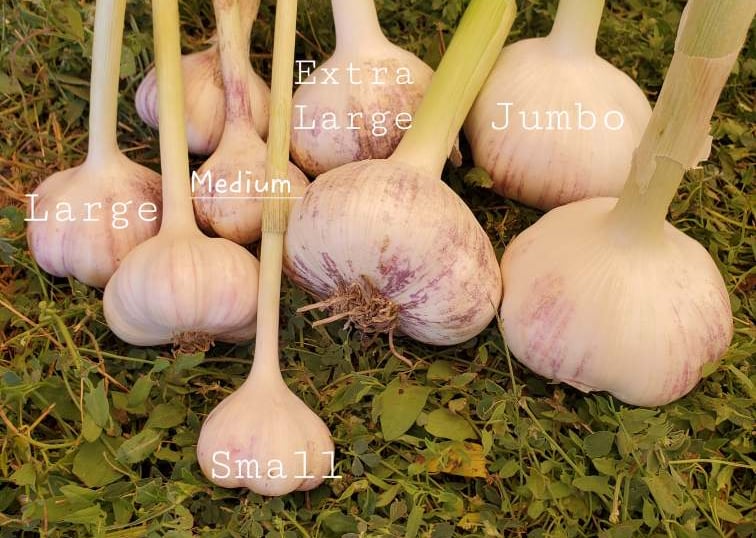
I grow all sizes (diameter):
Small - less than 1.5"
Medium - 1.5" to 2" (~14 bulbs/lb)
Large - 2" to 2.5" (~10 bulbs/lb)
Extra Large - 2.5" to 3", hard to grow (~5 bulbs/lb)
Jumbo - 3" and up, up to 8oz each, even more harder to grow, (~3.5 bulbs/lb)
Do to issues of "dead end genes" (read How to grow garlic), I don't sort garlic by size any more, but sort by year seed stock was grown.
To grow garlic (and all other vegetables/fruits), I use best agricultural practices, that go beyond standard Organic practices and beyond any conventional practices, combined. No "cides" of any kind - pesticides, herbicides, fungicides, etc. I start with doing comprehensive soil test analysis that costs about $150 per sample and doing several soil tests per year. Based on soil test analysis, I add necessary minerals and beneficial microorganisms, that comply with organic standards and go beyond that, and no conventional nitrogen fertilizers. Then, throughout the growing season I apply sea water minerals, seaweed extract, compost teas, lightning water (ozone treated water), sound vibration and intent. It is not an easy task nor a cheap one. It is also beyond regenerative farming practices, because not all regenerative farmers look into soil mineral balance; as well, its not only about soil mineral content - everything needs to be accounted, in a wholesome way.
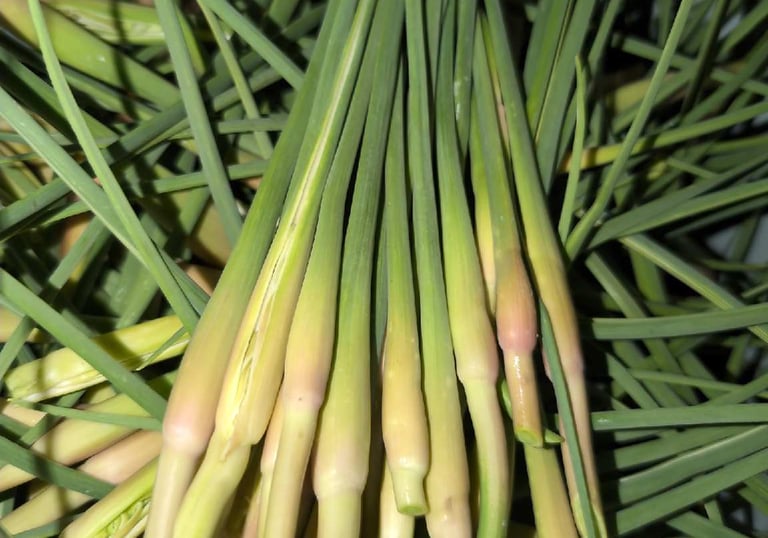
To grow extra large to jumbo size garlic, there is another caveat that makes it expensive to grow – loses as high as 31% to what I call “dead end genes” or “blind garlic”; the seed stock needs to be restocked ever year. By “seed stock” I mean I harvest garlic seed from garlic scapes (bulbils) after they bloom, and that’s how I restock my seed stock. To grow large to jumbo size bulbs, it takes 3-4 years. So a two year seed stock (bulbils collected in 2024) planted via cloves in fall of 2026 will be a three year seed stock at harvest in 2027, and then replanted via cloves in fall of 2027 will be a four year seed stock in 2028 and produce jumbo size bulbs. So, what happens, there is a thing that’s called blind garlic or what I call “dead end genes” - when garlic does not produce scapes (flowers) because of some kind of stressor and/or old age. When there is blind garlic, there are several things that might happen - after planting garlic it grows but terminates before emergence. If it emerges it has late emergence and then when it grows it looks just as healthy and good root system as all other garlic, but does not produce scapes or very poor scapes; because it is not developing properly it is very susceptible to diseases (disease is the secondary cause of growth failure, when blind/dead end genes is first cause), so either some of emerged blind garlic rots before it reaches stage of maturity, or it develops garlic heads but does not mature, disease sets and it will rot if not dug up at the time when other healthy garlic is producing scapes. The secondary nature of diseases does not affect good garlic that is not blind garlic, and the blind garlic phenomenon appears to be at random. After multi year study, figuring out what cases the blind garlic or dead end genes, I came to conclusion that the older the seed stock, the more chance of getting the blind garlic. In a two year seed stock I’ve seen about 2-3.5% blind garlic, while 4+ year seed stock up to 31%, the older it was the more susceptible it was. While my study focused on the age of seed stock, in botany its noted that the causes for blind garlic are stressors like extreme temperatures, water logging, mechanical or some other damage affecting the apical meristem (the growing point) before the scape is initiated. So if we add both, the age and the stressors, the conclusion I came to is that the older the seed stock is the more susceptible to stressors it will be. If I come across other information for causes of blind phenomenon, I’ll adjust my conclusions. You may plant the 4+ year stock garlic, the bigger the clove the bigger the bulb it will produce, but expect some % that will not produce a bulb.
How to grow garlic
GARLIC AVAILABILITY
This year, 2026, garlic harvest was not good and quantity planted was small. Sorry, no garlic available for sale this year. But you may pre-order for 2027, by contacting ask.bsl@pm.me and provide me with Your name, contact (email or phone number), and desired amount in pounds (see size and bulbs/lb above); God willing and garlic grows, it will be ready for pick up or shipping end of August - early September 2027. The $30/lb is anticipated/estimated price and most likely will change depending on economy and/or other unpredictables. Will do best to grow the best garlic you can have, but there are no guarantees of any kind that there will be good harvest if any. Reserve yours while available.
$30/lb
Garlic powder - $20 half pint jar
Shipping available. USPS shipping and handling (for 2025):
-$15 for small flat rate box (fits ~1 lb)
-$25 for medium flat rate box (fits 8-10 lbs)
Please contact 360-303-7395
Email: ask.bsl@pm.me
ask.bsl@pm.me
© Beyond Sustainable Life 2026. All rights reserved.